


Hoppa till innehåll / Skip to content
Price hedging and dedicated parks for energy-intensive industry→
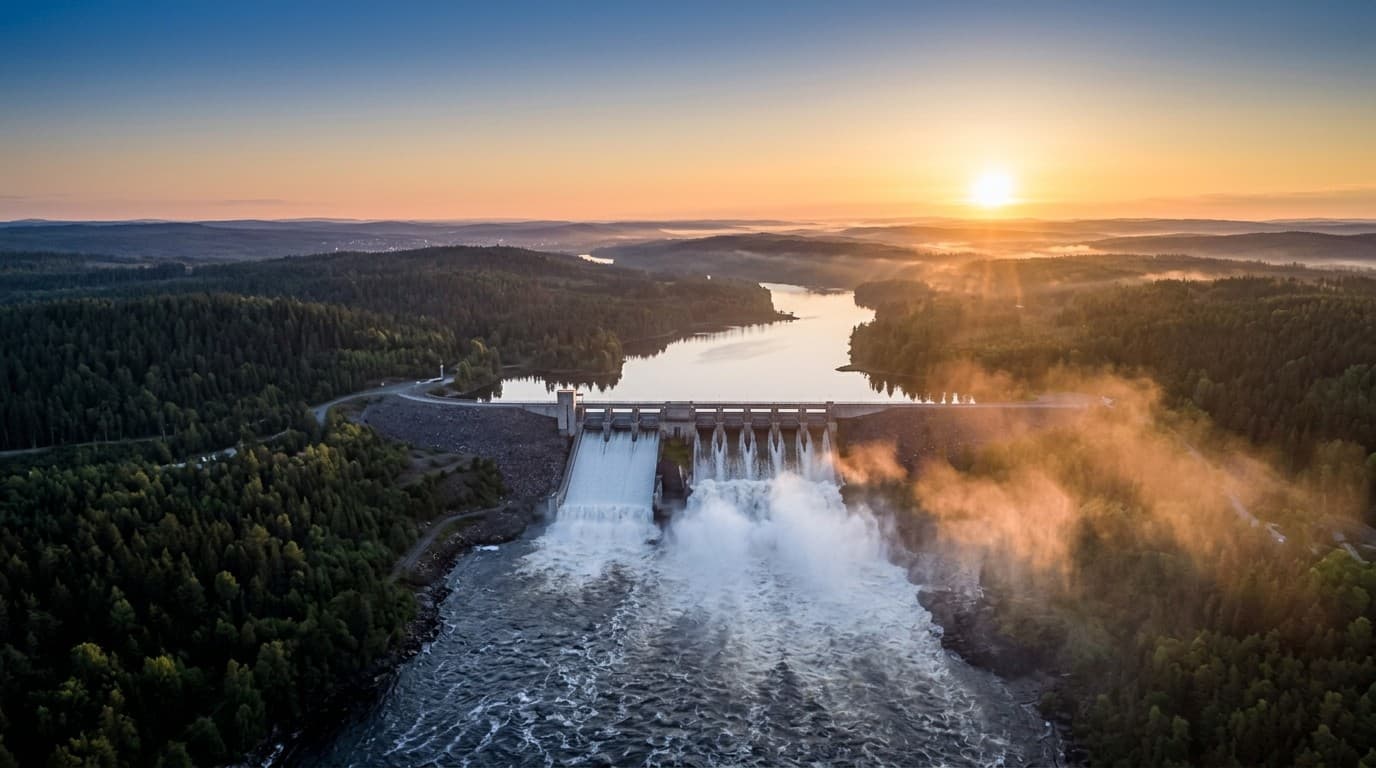
Hydropower plant with open spillway gates in a forested river valley at sunset, seen from the air

Power market

How the Swedish power market works.

Why does the electricity price go up and down? Why does southern Sweden often pay more than the north? And how much electricity will Sweden need by 2045? Here we explain the power market from the ground up, with sources from the authorities and the market’s own players.

Sunsurf Energypowered bySunstreet

01

How does electricity reach your business?

The electricity you use passes through four steps before it reaches you.

It is produced in power plants, carried by the grid and traded on the exchange before a supplier sells it on to you. In 2024 Sweden produced around 169 TWh, mainly from hydro, nuclear and wind.

The power system must be in balance every second. What is produced must match what is used, and the grid frequency is kept around 50 hertz. Svenska kraftnät is responsible for the balance and procures reserves that can raise or lower production and consumption at short notice.

The grid operator has a monopoly in its area and cannot be chosen. You can, however, freely choose your supplier and type of contract. For a business, the cost of electricity therefore has two parts: the power itself from the supplier and the transmission from the grid operator.

Sources: Energiföretagen (Energiåret 2024), Svenska kraftnät, Swedish Energy Markets Inspectorate

  • Production

    In 2024 hydro accounted for about 38 percent of production, nuclear for 29 percent and wind for 24 percent. Solar is still small but growing fast.

  • Grid

    The transmission grid, run by Svenska kraftnät, carries power over long distances. Regional and local grids take it the last stretch to you.

  • Exchange

    Most power is traded on exchanges, mainly Nord Pool, where buyers and sellers meet the day before delivery.

  • Supply

    The supplier buys power on the exchange and sells it on to you under the contract you have chosen.

  • Balance responsibility

    Every supplier has balance responsibility, or uses someone who does. The balance responsible party must plan so that power bought and sold evens out every quarter hour, and pays for any imbalances.

  • Intraday trading

    Once the day-ahead price is set, power can be traded on the intraday market until shortly before delivery. Producers and suppliers adjust their plans there as weather forecasts and consumption change.

02

How is the electricity price set?

The most expensive plant needed sets the price for all electricity.

The price is set on the exchange the day before delivery. Buyers and sellers submit their bids by noon the day before, and producers bid from cheapest to most expensive. Once demand is covered, the last bid needed sets the price for everyone.

When demand is low, cheap production such as hydro and wind is enough. When it is high, or when there is little wind, more expensive production is needed and the price rises for all power in that period. Since 1 October 2025 a new price is set for every quarter hour.

That is why the price can vary a lot within a single day. In the morning and early evening, when consumption peaks, the price is often higher than in the middle of the day and at night. For a business that uses power evenly around the clock, the swings feed straight into the cost of electricity.

Sources: Nord Pool, Svenska kraftnät, Swedish Energy Markets Inspectorate, Swedish Tax Agency (tax on electricity 2026), Spot prices SE4 2026, hourly averages from elprisetjustnu.se

  • Why marginal pricing?

    The model ensures the cheapest production is always used first, and sends a clear signal to build more when power is scarce.

  • What the bill consists of

    The power price is only part of the cost. On top come grid fees, energy tax, VAT and the supplier’s margin. Energy tax on electricity is 36.0 öre per kWh in 2026, excluding VAT. It is the power price that swings the most.

  • The grid fee

    The grid fee usually has a fixed part and a part per kWh. Many businesses also pay a capacity charge based on how much power is used at the same time. Evening out consumption can therefore lower the grid cost.

  • How much the price can swing

    On 14 September 2026 the difference between the cheapest and most expensive hour of the day in bidding zone 4 was almost 7 kronor per kWh. The most expensive hour averaged 8.30 kronor per kWh, more than eight times the year’s average price.

03

Why is electricity more expensive in southern Sweden?

Electricity is produced in the north but used in the south, and the lines in between are not always enough.

Since 1 November 2011 Sweden has been divided into four bidding zones, from SE1 in the north to SE4 in the south. The borders run where transmission capacity in the grid is limited.

The division was introduced after the European Commission questioned Svenska kraftnät limiting exports of power to keep prices down in Sweden. With bidding zones, the lack of transmission shows up in the price instead, and the price shows where more production and more lines are needed.

When the lines between north and south are full, prices can differ between the zones. Southern Sweden is also more closely connected to the more expensive continental market, and its own production has fallen since the reactors at Barsebäck and four of the reactors at Oskarshamn and Ringhals were closed. That is why prices in SE3 and SE4 are often higher.

Between 1 January and 8 October 2026 the spot price in SE4 averaged 97 öre per kWh, against 77 öre in SE3. That is just over 25 percent higher, and SE4 was more expensive than SE3 in 77 percent of the year’s hours.

Sources: Svenska kraftnät, Swedish Parliament, Spot prices SE3 and SE4 2026, hourly averages from elprisetjustnu.se (1 January–8 October), European Commission (case COMP/39351, Svenska kraftnät)

  • Which zone are you in?

    It depends on where the site using the power is located, not where the company is registered. The zone is often shown on the invoice, and your grid operator can always tell you.

  • The four zones

    SE1 Luleå and SE2 Sundsvall have plenty of hydro and low consumption. SE3 Stockholm and SE4 Malmö have most of the consumption and receive power from the north when their own production is not enough.

  • Where the price difference goes

    When prices differ between two zones, so-called congestion income arises and goes to Svenska kraftnät. Under EU rules the money must be used to expand transmission or keep grid fees down.

  • Local production in the south

    New production close to consumption in SE3 and SE4 reduces the need to move power south. It is one of the most direct ways to narrow the price gap with the north.

04

How does Europe affect electricity prices in Sweden?

When prices rise in Europe, southern Sweden often follows.

Sweden has interconnectors to Norway, Finland, Denmark, Germany, Poland and Lithuania. Power flows to where the price is highest, which pulls prices towards each other.

In many European countries gas power often sets the price. When gas prices rose sharply during the 2022 energy crisis, power prices in southern Sweden reached record levels.

The connections have benefits. When it is windy Sweden can export power, and when its own production is not enough power can be imported. But they also mean that the price in southern Sweden often follows the price level in the neighbouring countries to the south.

Sources: Svenska kraftnät, Swedish Energy Agency, Spot prices SE3 and SE4 2026, hourly averages from elprisetjustnu.se, Nord Pool (flow-based market coupling)

  • Weather, wind and water

    Dry years with little water in the reservoirs, calm weeks and cold winters push prices up. Windy, rainy periods with low consumption push them down, sometimes below zero.

  • Negative prices

    Between 1 January and 8 October 2026 the spot price was negative for 84 hours in SE4 and 73 hours in SE3. Even then, grid fees, energy tax and VAT still apply.

  • Emission allowances

    Within the EU, fossil power plants must buy emission allowances for their carbon dioxide. A higher allowance price makes coal and gas power more expensive, and can therefore raise the power price in Sweden too when those plants set the price.

  • A common market

    Day-ahead prices across much of Europe are calculated at the same time in a common calculation that takes into account how much power can flow between countries. Since autumn 2024 a flow-based method has been used in the Nordics, based on how power actually flows in the grid.

05

How much electricity will Sweden need in 2045?

The power system must handle more than twice as much electricity as today.

Sweden is to reach net zero greenhouse gas emissions by 2045. That requires industry and transport to switch to electricity: fossil-free steel, battery factories, hydrogen, electric cars and data centres.

In 2024 Sweden used 136 TWh of electricity. The power system is to be planned for at least 300 TWh in 2045. Svenska kraftnät expects consumption to rise significantly, but lowered its forecast slightly in June 2026.

Electricity use has stayed at roughly the same level for several decades. What is new is that large industrial projects and the electrification of transport need a lot of power in a short time, often in places where the grid is already under strain.

Sources: Ekonomifakta, Svenska kraftnät (Long-term market analysis 2026), Swedish Environmental Protection Agency

  • Why renewables?

    Wind and solar can be built in a few years, while new nuclear takes considerably longer. That makes renewables crucial for meeting demand in the coming years.

  • Flexibility

    More solar and wind also means more need for storage, dispatchable production and users who can shift their consumption. Solar and wind also complement each other across the day and the year.

  • Solar in Sweden

    Solar panels produce most in the summer half of the year and in the middle of the day. Solar parks can be built quickly and close to consumption, which relieves the grid.

06

Why is the build-out so slow?

Getting permits takes longer than building.

A new transmission line can take 10–15 years to put in place, and only about a tenth of that time is the actual construction. The rest goes on planning, permits and appeals.

Onshore wind also requires the municipality’s approval, and many projects stop at that step. In many parts of the country there is also a queue to connect larger plants, and the grid operator may need to expand the grid before a new park or factory can be connected.

That makes it increasingly important to use areas that are already affected, such as landfills, ponds, quarries and industrial land. There are fewer land conflicts there, and a grid connection is often already nearby.

Sources: Företagarna (consultation response, SOU 2019:30), WSP, Svenska kraftnät, Environmental Code ch. 16 sec. 4

  • Why solar parks are faster

    Once permits and the connection are in place, a solar park can usually be built in a few months. It is the choice of site, and how quickly it can be connected, that sets the timeline.

  • Competition for land

    Farmland, forest, nature and housing compete for the same areas. Building on water and on land already used for something else reduces that conflict.

07

What does it mean for your business?

How you buy electricity decides how much the swings affect you.

With a spot price you follow the exchange, peaks and troughs alike. A fixed price gives predictability, but reflects the market on the day you sign. With price hedging through new production you get a stable price and help new renewable power get built.

Guarantees of origin show which energy source the power comes from, but do not guarantee that new production is built. One guarantee of origin corresponds to one megawatt hour and is issued by the Swedish Energy Agency.

More and more companies also need to report where their electricity comes from. Under the GHG Protocol, emissions from purchased electricity are reported both on the basis of the grid mix and on the basis of the company’s contracts and guarantees of origin. A long-term power purchase agreement linked to a specific park also shows that the purchase contributes to new production.

FeatureSpot priceFixed priceHedging through new generation
Predictable electricity costNoYesYes
Follows the exchange when prices are lowYesNoFor the share you do not hedge
Helps new renewable generation get builtNoNoYes
You know which park your power comes fromNoNoYes

Sources: Swedish Energy Agency (guarantees of origin), Act (2010:601) on guarantees of origin, GHG Protocol (Scope 2 Guidance)

  • Variable price

    You pay the spot price plus the supplier’s margin. It is cheap when prices are low, but gives no protection when they rise.

  • Fixed price

    The price is locked for a set period. It gives predictability, but the level reflects market expectations on the day you sign.

  • Power purchase agreement (PPA)

    A long-term agreement linked to a specific production plant. The price is fixed, and you know where the power is produced.

Common questions about the power market.

Click a question to read the answer

  • Much of the electricity is produced in the north, while much is used in the south. The lines between north and south have limited capacity, and southern Sweden is also more closely connected to the more expensive continental market. That is why prices in SE3 and SE4 are often higher than in SE1 and SE2.

  • The spot price is the electricity price set on the Nord Pool exchange the day before delivery, separately for each bidding zone. Since 1 October 2025 a new price is set for every quarter hour instead of every hour. With a variable contract, your price follows the spot price.

  • Between 1 January and 8 October 2026 the spot price averaged 97 öre per kWh in SE4 and 77 öre per kWh in SE3, just over 25 percent higher in SE4. The gap varies a lot from hour to hour and is largest when the lines from the north are full.

  • The energy tax on electricity is 36.0 öre per kWh in 2026, excluding VAT, according to the Swedish Tax Agency. In some parts of northern Sweden the tax is lower for households and service businesses.

  • An electronic certificate showing how one megawatt hour of electricity was produced, for example by wind or solar power. Guarantees are issued by the Swedish Energy Agency and can be sold separately from the electricity. They show where the electricity comes from, but do not in themselves lead to new generation being built.

  • It depends on where the site using the electricity is located, not where the company is registered. Your grid operator can tell you which zone the site is in, and it is often shown on the invoice.

  • You pay the electricity price to your supplier for the electricity itself, and it varies with the market. You pay the grid fee to your grid operator for transporting the electricity to you. The grid operator has a monopoly in its area, and the Swedish Energy Markets Inspectorate caps how much it may charge.

  • When production in a bidding zone exceeds consumption and the electricity cannot be moved elsewhere, for example on windy, sunny days with low demand, the price can turn negative. Grid fees, energy tax and VAT still apply.

  • No one can say for sure. Rapidly rising demand points to higher prices if the build-out does not keep pace, while more new generation and more lines point to lower ones. What is certain is that prices will keep swinging.

  • By locking all or part of its electricity cost, either with a fixed price from a supplier or by hedging electricity from new generation. A stable price makes budgeting easier and reduces the risk during price spikes.

  • Nord Pool normally publishes the day-ahead prices for the next day shortly after 1 pm Swedish time. There is then a price for every quarter hour and every bidding zone.

  • With a variable price you pay the spot price plus the supplier’s margin, and the cost follows the market. With a fixed price you lock the price for a set period. That gives predictability, but the level is set by the market on the day you sign.

  • A PPA, power purchase agreement, is a long-term agreement to buy power linked to a specific production plant, such as a solar park. The buyer gets a fixed price and knows where the power is produced, and the agreement makes it possible to build new production.

  • A part of the grid fee based on how much power you use at the same time, often the highest consumption during a given period. For businesses with high peaks it can be a large part of the grid cost.

  • Svenska kraftnät is the state authority for the transmission grid. It keeps production and consumption in balance, sets the borders between the bidding zones and expands the national grid.

  • By shifting consumption to hours and quarters with lower prices, evening out power peaks to lower the grid fee, and producing its own power. Solar panels on its own land or on a nearby pond reduce the amount of power that has to be bought and carried through the grid.

    Want to avoid the swings in electricity prices?

    With hedged electricity from new renewable parks, you know what your electricity costs, and where it comes from.

    What is included

    Price-hedged power from Sunsurf Energy gives you


    • Low price
    • Fixed price
    • 100% renewable
    • Produced at a local solar park
    • No need to switch supplier
    • Long-term security

    See your price

    Fill in a few details and your price appears right away.

    Price area